

Market Reactions to Fed Rate Cuts
Published 9/26/2024
As the Fed embarks on its first cut in September it is important to look back at recent history to examine how the market reacted on a go forward basis. The diagram below examines the S&P 500 returns after the first cut in the past ten cycles. This analysis provides insights into historical market reactions following such rate cuts, helping investors anticipate potential market trends in the aftermath of the Federal Reserve's decision to cut interest rates. By studying these historical patterns, investors can better understand how the market might behave following the upcoming rate cut.
S&P Returns After the First Cut in the Past 10 Cycles (1984-2020)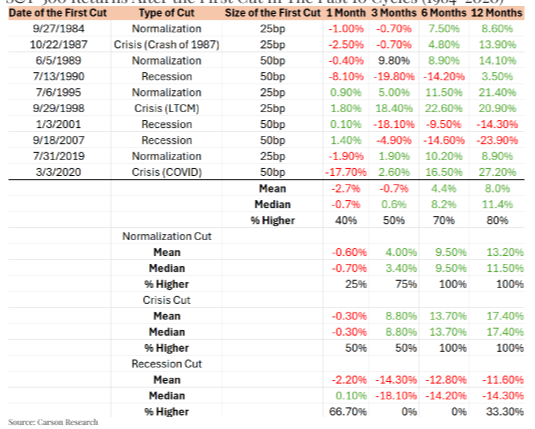
Here are some key takeaways from the information provided:
- Historically, the S&P 500 has experienced positive returns 80% of the time in the 12 months following the first Federal Reserve rate cut, with an average return of 8%.
- The reason behind a Federal Reserve rate cut plays a crucial role in determining the market's return outcome - not all cuts are the same.
- In instances where Federal Reserve rate cuts are made in response to a recession, the S&P 500 has historically tended to experience declines moving forward, regardless of the time frame considered.
- When Federal Reserve rate cuts occur outside of a recessionary environment, the S&P 500 has historically shown a strong tendency to rise.
Past performance does not guarantee future results. Investing involves risk, including loss of principle.